
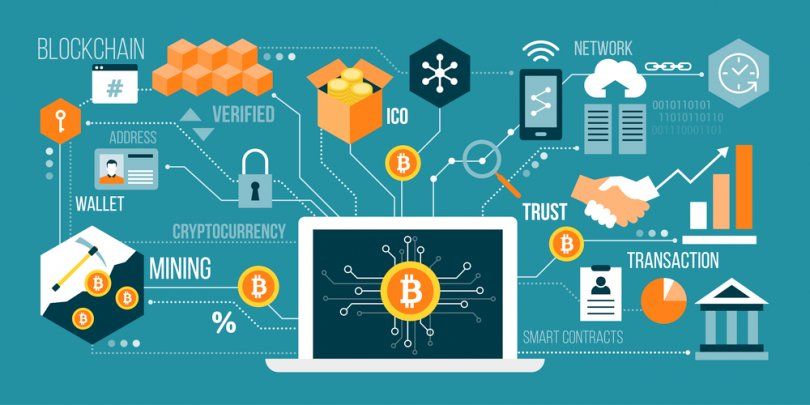
The advent of cryptocurrency has transformed the economic scenario. Cryptocurrencies like Bitcoin and Ethereum are based on secure, transparent, and decentralized technology called blockchain; in contrast to traditional currencies controlled by banks and governments. What are the technological roots of cryptocurrency? Why is it considered revolutionary? Let’s make it easier.
Blockchain Technology
A new type of currency has emerged utilizing a new technology called ‘blockchain.’ Instead of traditional financial institutions, digital tokens use a mathematical system to move currency as a digital token with no geographical limits. There are no bank personnel, cash vaults, or other traditional forms of security. Tokens are secured by multiple layers of code.
Because traditional currency can be duplicated, stolen, and defrauded, digital tokens use a system of proof and mathematical verification to ensure that every digital token is secured.
History of Bitcoin and Ethereum
The two best-known examples are: born in 2009, Bitcoin stands as the original digital money. Often called digital gold, it started a shift in how value moves online.
Launched back in 2015, Ethereum isn’t just another digital ledger. Instead, it opened doors to self-executing agreements coded right into the system. Because of that shift, programs now run without central oversight. While others focused on payments, this network built spaces where code acts like law. Its currency, ETH, fuels these operations behind the scenes.
Bitcoin supports a peer-to-peer system of payment that is not reliant on a central banking system. It uses the concept of blockchain as follows: a sequence of records grows steadily within a digital structure known as a blockchain.
One entry follows another, each confirmed before attachment. Information persists across many machines globally. This shared record stays visible to all participants involved. To verify any transaction, a proof of work is required and is verified through a puzzle. Once the puzzle is solved, new Bitcoins are created and the transaction is rewarded.
Digital Wallet
A digital wallet is a requirement for receiving and making transactions in Bitcoin. It is a digital account that stores the coins. Value and scarcity are at the same time guaranteed by the highest Bitcoin limit. In short, Bitcoin works just like money in a physical form and is made secure by technology and not banks.
Blockchain and Ethereum
Ethereum enables developers to build new programs on the blockchain, making it the world’s computer. It also makes possible something beyond simply sending money. Smart contracts are computer programs enforcing contracts that dominate the blockchain and are run independently upon specified conditions.
A good example is when the payment automatically gets released upon delivery of the products. Ethereum (ETH) is the digital money behind Ethereum.
Uses of Blockchain and Smart Contracts
People mainly use it for paying fees on transactions and making smart contracts on the blockchain. Decentralized apps on Ethereum cover a lot more than just games. Think finance, healthcare, and more. Ethereum’s a pretty adaptable blockchain. It not only handles transactions but also makes it easier to build digital apps and smart contracts.
Decentralize Networks
The decentralized networks and the cryptography used by Bitcoin and Ethereum make them secure. Verification of transactions is conducted by more than one computer (nodes) rather than hand over to one entity. Blockchain is a decentralized book for transactions. Information that gets recorded is unalterable. Users manage private keys that are similar to digital signatures, confirming their identity. This spectrum of decentralization and distributed resources protects systems against hacking attempts that are focused.
Conclusion
The use of these coins is varied as follows: some companies process payments in Bitcoin and Ethereum. People buy and store these coins as digital assets. Ethereum enables the use of bankless systems of generating interest, lending, and borrowing. Ethereum supports transactions of digital art and collectibles, and in-game assets related to computer games.
Also Check Best AI Tools in 2026 – Comprehensive Guide







Leave a Reply